Giving hope and empowering through aquaculture

  • -

Giving hope and empowering through aquaculture

Category:Updates

May 2013 issue of International Aquafeed magazine – AwF Blog

This is the first of what will be a regular blog/column that will bring you news and information about Aquaculture without Frontiers (AwF) and the issues that surround our organisation. We are grateful to the magazine in giving us this opportunity.

AwF is an organization of global volunteer aquaculture professionals who network; who are passionate about aquaculture and its ability to engage, train and feed the disadvantaged; and who create initiatives, projects and programs.

AwF was the brainchild of Michael New OBE, CBiol, FSB, BSc, ARCS, FIFST; Past President World Aquaculture Society (WAS) and European Aquaculture Society (EAS). Michael is still alive and well and is much revered person globally but he is trying to take a backseat and allow others to drive AwF. 
Read More

  • -

Developing country student support for advanced fisheries and aquaculture economics course

Category:Updates

A Tribute to Prof. M.C. Nandeesha (1957 – 2012)

Under the Sponsorship of FAO-FIPM, the organizers will provide 8 bursaries for students from developing countries according to the following specifications:

a) Contribution to cover travel, lodging, meals and incidental expenses of four participants from developing countries from the Mediterranean countries, in particular North Africa and the Near East.
b) Contribution to cover travel and living expenses of four participants from other developing countries (Africa, Asia and South America).

Deadline for applications is May 17th.

For further information and applications please send CV to:
Mr. Ignacio Llorente García
Grupo-IDES
Universidad de Cantabria (Spain)
Email: Ignacio.Llorente@unican.es

Read More

  • -

Aquaculture takes off inTimor-Leste to tackle poverty

Category:Updates

The government of Timor-Leste has developed a National Aquaculture Development Strategy, designed to help reduce high levels of poverty and chronic malnutrition throughout the country.

Minister of Agriculture and Fisheries, Mariano Assanami Sabino, endorsed the strategy stating that combating poverty and malnutrition has been a foremost priority of the government since its independence in 2002.

Developed with assistance from WorldFish, the strategy spans from 2012 to 2030 and will focus on building new infrastructure and technical ability to support aquaculture enterprises, which will also lead to improved economic growth.

Excellency Assanami says that developing aquaculture will bring much needed benefits to the country.

“Aquaculture contributes to food and nutrition security and resilience, diversification of livelihoods of inland and coastal communities, and economic growth in Timor-Leste,” he says. Read more …


  • -

Nandeesha Medical Assistance Fund update

Category:Updates
Prof. M.C. Nandeesha

Prof. M.C. Nandeesha

Courtesy of several colleagues and friends, we have the following update on our efforts to raise funds to pay Dr Nandeesha’s medical expenses after his unfortunate passing last December 2012.

Recent details provided by Ms Nandeesha indicate that total contributions from all sources amounted to INR 3.5 million (USD 64,800 approx) and were applied to the hospital bill of INR 4.0 million (USD 74,000 approx). Apparently the Hospital reduced the bill from INR 4.5 million to INR 4.0 million. We are not able to discern from statements how much has come from different sources/countries. The balance owing was paid off from other contributions received.

Ms Nandeesha is grateful to all those who contributed and indicated that she would not require further assistance. She requested that we post this tribute so that all who gave so generously would know of her gratitude. 

Read More

  • -

Wiley Online Books made available in developing countries via Research4Life

Category:Updates

John Wiley & Sons, Inc., recently announced that its 12,200 Online Books would be made available through the Research4Life initiatives of HINARIAGORA and OARE, benefitting research and academic communities in 80 low- and middle-income countries including Malawi, Cambodia, and Bolivia.

Research4Life provides 6,000 institutions in developing countries with free or low cost access to peer-reviewed online content from the world’s leading scientific, technical and medical publishers. The addition of Wiley’s Online Books brings the total number of peer reviewed scientific journals, books and databases now available through the public-private Research4life partnership to almost 30,000. 

Read More

  • -

AwF co-executive director Roy Palmer elected director of World Aquaculture Society

Category:Updates
Roy Palmer

Roy Palmer

Australian aquaculture/seafood veteran Roy Palmer has been named Director of the World Aquaculture Society (WAS) following its 2013 board elections.

The international not-for-profit organisation aims to promote sustainable aquaculture by facilitating and strengthening information exchange among academics and the industry. With over 3000 members in over 100 countries, WAS targets high priority issues in aquaculture and helps to raise awareness of aid initiatives in developing countries.

With over 40 years of experience in the import, export, marketing and retail of post-harvest aquaculture, Roy joined WAS more than 10 years ago and soon after became President of the Asia-Pacific Chapter (APC).

“This position is an opportunity for me to ask others their opinions on current issues in the industry and help generate discussion on a global scale. My aim is to try to make a difference and I don’t intend to waste my time in this role,” Roy explains.

“As president of the APC my first priority was to establish boundaries. We created an expert advisory council and roles for country ambassadors to talk more effectively about the issues within each region and discuss possible solutions.”

Since then Roy’s passion for the industry has led to him becoming heavily involved with Aquaculture Without Frontiers — a charity which aims to assist impoverished communities in establishing aquaculture and educating people on the harvesting process to improve health and business.  Read more …


  • -

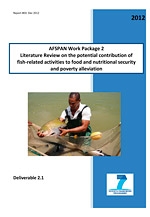
Literature Review on potential contribution of fish-related activities to food and nutritional security and poverty alleviation

Category:Updates

afspan-literature-reviewThe objective of this document is to review the literature that has been published so far on the potential contribution of fish-related activities (aquaculture and fisheries) to food and nutritional security and poverty alleviation. This body of literature – which is found essentially in the aquaculture/fisheries literature, but also for some parts in the nutrition literature – turns out to be relatively heterogeneous and scattered, relying on different types of indicators and data. This information, which has been generated by different methodologies, applied at various scale (household, community, national levels), offers therefore very limited possibility for rigorous comparison or aggregation across projects, location or countries. 

Read More

  • -

Rebuilding the Tambaks in Aceh

Category:Updates

Rebuilding the Tambaks in Aceh is a video by Visual Backstories that features Pak Mohammad, a charismatic leader in his village, who works with local and international experts to bring back aquaculture, or rather a polyculture system, to the brackish water ponds (tambaks) following the devastating tsunami on Boxing Day, 2004.

AwF Director Kevin Fitzsimmons is shown touring the various reconstruction projects undertaken with funding from a number of aid agencies, foundations, and non-profits, including Aquaculture without Frontiers (AwF).

The people of Aceh have transformed the devastation into once more productive ponds, rebuilding their lives and communities in the process.

Rebuilding the Tambaks in Aceh


  • -

Feeding the 9 billion: The tragedy of waste

Category:Updates

IMechE Food Report CoverBy 2075, the United Nations’ mid-range projection for global population growth predicts that human numbers will peak at about 9.5 billion people. This means that there could be an extra three billion mouths to feed by the end of the century, a period in which substantial changes are anticipated in the wealth, calorific intake and dietary preferences of people in developing countries across the world.

Such a projection presents mankind with wide-ranging social, economic, environmental and political issues that need to be addressed today to ensure a sustainable future for all. One key issue is how to produce more food in a world of finite resources.

Today, we produce about four billion metric tonnes of food per annum. Yet due to poor practices in harvesting, storage and transportation, as well as market and consumer wastage, it is estimated that 30–50% (or 1.2–2 billion tonnes) of all food produced never reaches a human stomach. Furthermore, this figure does not reflect the fact that large amounts of land, energy, fertilisers and water have also been lost in the production of foodstuffs which simply end up as waste. This level of wastage is a tragedy that cannot continue if we are to succeed in the challenge of sustainably meeting our future food demands.  Read more …


  • -

Experienced aquaculture project supervisor wanted in Mozambique

Category:Updates

The Manda Wilderness Community Trust (MWCT)  is seeking an experienced aquaculture project supervisor to work in the Lago District, Niassa Province, Mozambique.

Description of Role:

  • Manage and organize the work schedules and progress of an 18 member community association
  • Design and adjust short-term and long-term plans on a grassroots and rural aquaculture project
  • Take frequent camping trips to the picturesque village of Litanda
  • Learn and improve Portuguese and Nyanja language skills
  • Help bring improved nutrition, capacitation and leadership skills to the community association, Litanda village and surrounding communities 
    Read More

Archives