Championing Gender in Fisheries
Category:Updates13 January, 2025
Nikita Gopal
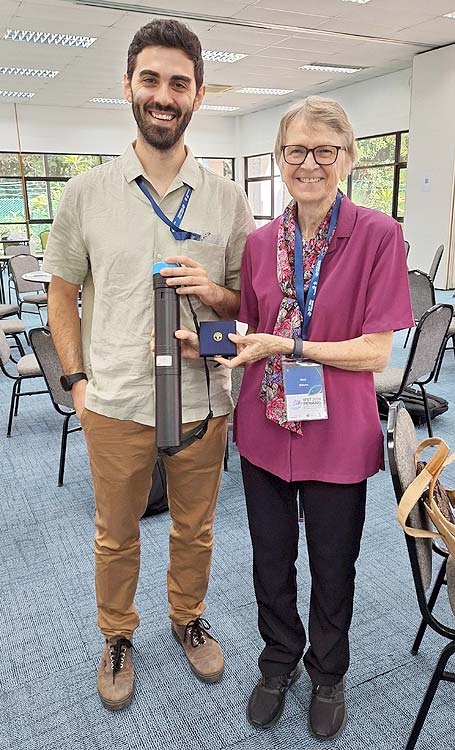
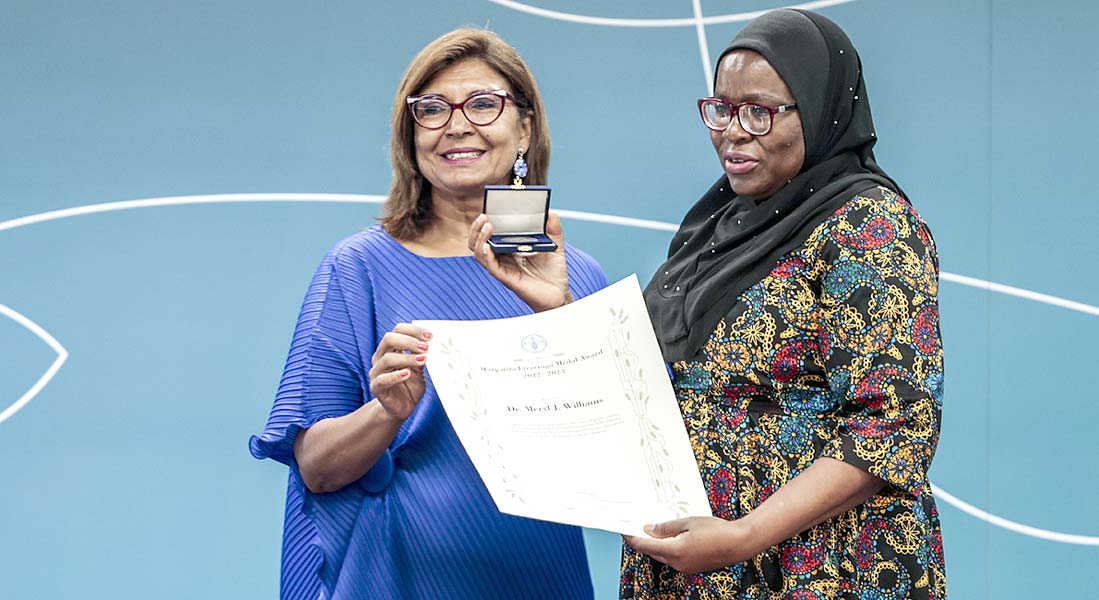
In honour of Meryl Williams who received the Margarita Lizárraga Medal, at the 36th Session of the Committee on Fisheries (COFI)
The latest addition to the long list of awards received by Meryl J. Williams, is the Margarita Lizárraga Medal, presented during the opening of the 36th Session of the Committee on Fisheries (COFI) at the United Nations Food and Agriculture Organisation (FAO) headquarters. In the award announcement, the Committee noted:
“Meryl is a tireless, substantive, and globally well-respected advocate for matters of gender, globalization, and development in the fisheries and aquaculture arena, sharing science-based knowledge and experiences on the ground, in academic dialogues, and in local and global fora. Her inspirational leadership and mentorship—both first-hand and through the various platforms she has created—are heralding a new generation of leaders in gender in fisheries and aquaculture firmly on the global fisheries, aquaculture, and development agenda.”
Awards often reinforce what is already known about a person. Meryl Williams has dedicated over 45 years to Australian and international fisheries, aquaculture, aquatic resource conservation, and agricultural research and development. She began her career as a secondary school teacher in Queensland in 1973 after earning a Diploma in Education. She later returned to university, earning a First-Class Honours degree in Science and a PhD in Zoology. Her entry into fisheries began as a Fisheries Biometrician with the Queensland Fisheries Service (1977–1981) and as a Fisheries Statistician for the Tuna and Billfish Assessment Program at the South Pacific Commission in Noumea, New Caledonia (1981–1984).
She has held senior positions including Director of the Fisheries Resources Branch at the Bureau of Rural Resources, Department of Primary Industries and Energy, Canberra, Australia (1986–1990), Executive Director of the Bureau (1990–1993), and Director of the Australian Institute of Marine Science, Townsville, Australia (1993–1994).
Meryl continues to lead research on gender and aquaculture, focusing on equitable fish production systems for food security.
Meryl became Director General of WorldFish in 1994, then known as the International Centre for Living Aquatic Resources Management (ICLARM), headquartered in Manila, Philippines. She oversaw its relocation to a new campus in Penang, Malaysia, in 2000. During a visit to WorldFish in July 2024, she vividly recounted how each building had been constructed—20 years after she left the organization. As Director General (1994–2004), she focused WorldFish’s efforts on eradicating poverty, improving nutrition, and reducing environmental pressures. Her leadership supported transformative work by her deputy, Modadugu Vijay Gupta, whose innovations in low-cost freshwater fish farming earned him the World Food Prize in 2005.
Meryl credits her deep interest in women and gender in fisheries to initiatives by M.V. Gupta and the late Prof. M.C. Nandeesha. Prof. Nandeesha organized the first Women in Fisheries Workshop in India during the 2nd Indian Fisheries Forum in 1990. Gender-focused events like Women in Cambodian Fisheries in 1994 and the Women in Fisheries photo competition at the 4th Asian Fisheries Forum (AFF) followed. Later, the 6th AFF in Taiwan and the 7th AFF in Penang hosted global symposia on women in fisheries. WorldFish supported publications from these events.
In 2008, on the sidelines of the 8th Asian Fisheries and Aquaculture Forum (AFAF) in Kochi, India, Meryl organized an informal networking meeting to discuss advancing gender in aquaculture and fisheries. Despite a modest turnout, the discussions were profound, highlighting challenges and charting a path forward. A small team under her leadership continued to organise the GAF Global Conferences (e.g., GAF3 in Shanghai, GAF4 in Korea, GAF5 in India, GAF6 in Thailand) during the AFAFs, where the network meetings also continued, distilling the need for a Section. Meryl’s sustained efforts in the AFS Council culminated in the formation of the Gender in Aquaculture & Fisheries Section (GAFS) of the Asian Fisheries Society, which was officially inaugurated in 2017. Meryl served as its founding Chair (2017–2022).
GAFS has since developed initiatives, including the GAFS Statement on Gender Equality – From Catch to Consumer: Why Gender Equality Matters in Aquaculture and Fisheries. This statement underscores the significance of gender equality for fisheries and aquaculture, where women comprise about half the workforce. It also highlights the systemic injustices faced by fisherwomen and the need for data and advocacy to address these inequalities. Gender inequality negatively impacts food and financial security, family nutrition, and community stability.
Meryl continues to lead research on gender and aquaculture, focusing on equitable fish production for food security. She serves as Vice Chair of the Scientific Advisory Committee of the International Seafood Sustainability Foundation and a board member of Aquaculture without Frontiers (Australia).
On a personal note, my acquaintance with her began at the 2008 Kochi gender networks meeting, which sparked an enduring friendship. She is a mentor, philosopher, and guide to many, touching our lives uniquely. She inspires and encourages people to excel, and generously shares valuable insights from her vast knowledge and experience. Meryl is a true champion for ALL WOMEN in fisheries.
The article appeared in Yemaya #70 and is reprinted with kind permission of ICSF.
This article is available at : https://icsf.net/yemaya/gender-portrait-championing-gender-in-fisheries/


